Dental Crowns in Harley Street, London
Support for a tooth that needs more than a filling.
Discuss dental crowns
Support for a tooth that needs more than a filling.
A dental crown is a restoration that covers a tooth. It may be considered when the remaining structure needs more support than a filling can provide, or as part of restoring a tooth after other treatment. Your dentist explains why it is being recommended for that particular tooth.
Call 020 4634 9203 or SMS 07456 441350 for non-urgent enquiries. Your concierge will confirm availability and the next steps. Please avoid sending sensitive medical details by SMS.
- Care route
- Repair
- Starting point
- Individual clinical assessment
- Location
- 66 Harley Street, London W1G 7HD
- Fees
- From £995 per tooth
Before & after
Explore our treatment photographs. Select an image for a closer look.
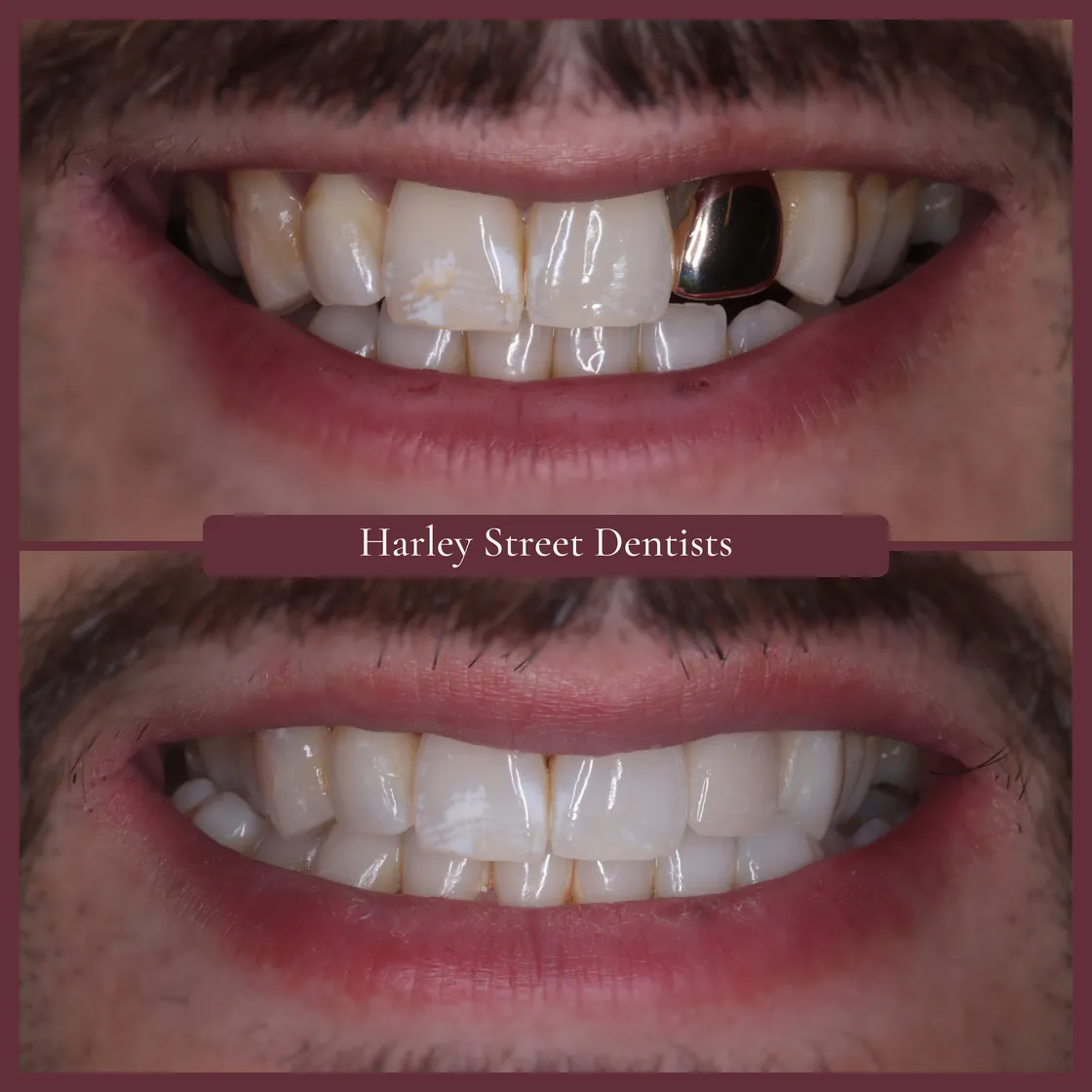
What the assessment considers
The condition of the tooth, existing restorations and your bite influence the options. A crown is not always necessary, and alternatives may be available. Ask how the proposed restoration addresses the problem and what would happen without it.
Treatment suitability, risks and alternatives are discussed at your assessment. Your written plan explains the care proposed and its fees.
Further reading: independent or manufacturer background information ↗. Your clinical plan is individual.
Your treatment, understood
When a tooth needs more than a filling.
A crown covers a prepared tooth. It may be considered when the remaining tooth needs support or substantial restoration. The decision should follow the tooth’s condition and bite, with alternatives explained before preparation begins.
Remaining tooth structure
Ask what is supporting the planned restoration.
The size of an existing filling, cracks and the condition of the tooth influence the options.
Other treatment
Check whether additional care is needed first.
A build-up or root canal treatment may be relevant in some cases; it is not automatically part of every crown plan.
The finished tooth
Fit, bite and cleaning matter alongside colour.
Confirm the proposed material and the maintenance arrangements rather than choosing by appearance alone.
How the treatment is planned
Assess the tooth
Discuss whether it can be restored and compare suitable alternatives.
Prepare and record
The dentist prepares the tooth and takes the records needed; ask about any temporary restoration.
Fit and check
The crown’s fit and bite are checked, with advice on cleaning around its edge.
Questions before deciding
Is a crown the same as an implant?
No. A crown can cover a natural tooth, or form the visible tooth on an implant. The underlying support and treatment sequence are different.
Will I always need root canal treatment?
No. It depends on the condition of the tooth. Ask whether it is indicated and whether it is included in the estimate.
Can decay occur around a crown?
The remaining natural tooth still needs care. Cleaning at the gum line and regular checks help maintain the restoration and supporting tissues.
Treatment fees
Ceramic crowns from £995 per tooth. The estimate identifies any separate procedures, such as root canal treatment, and the complete proposed care.
Where an examination is followed by an agreed treatment plan, the examination amount paid is credited once. The treatment deposit is 10% of the remaining balance after this credit.
Full fees and arrangements ↗Questions about dental crowns
Is a crown the same as a veneer?
No. A crown covers more of the tooth, while a veneer covers its front surface. The appropriate choice depends on the clinical problem and the tooth structure.
Does the fee include root canal treatment?
Root canal treatment has a separate starting fee of £795. Your itemised plan explains whether it is needed and how the total is calculated.
Your concierge ↗Will I need a temporary crown?
That depends on the proposed process. Your dentist explains how the tooth will be managed between stages.
How long will a crown last?
Longevity varies with the tooth, restoration, bite and care. Discuss maintenance and possible future replacement rather than expecting a fixed lifetime.
Treatment suitability, risks and alternatives are discussed at your assessment. Your written plan explains the care proposed and its fees.